
When pondering what to write about this month I have reflected on several Shakespearian matters that have come my way over the past few years.
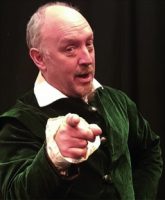 Just recently I was invited by Linda Weekes to attend a one man play she was sponsoring at Blackham called ‘Your Baird – an informal audience with Will Shakespeare’ performed by the very talented professional actor Nicholas Collett. The show is set in two parts, the first half is a lecture given by Professor Nother providing a convincing argument that Shakespeare didn’t write the plays at all. The second half is Will himself defend his reputation telling us all about his family, what it was like on tour and his glory days at the Globe. We met Queen Elizabeth I, Christopher Marlowe and Ned Alleyn and the play was Intermingled with a few of his greatest hits, sonnets and songs. A very funny show and an excellent evening.
Also In the summer of 2015 we were asked to put on a 15-minute comedy play at Penshurst Fete following the roaring success of Hamlet in 2014. Our great script writer and comedy extraordinaire Rob Rees put pen to paper and took all the boring stuff out of Romeo and Juliet and cut the two and a half hour play down to 15 minutes of comedy. Being in my 50’s balding and slightly overweight I was of course the natural choice to play Romeo and for the first time I was reading and quoting Shakespeare. Rehearsals were held in John O’shea’s garden much to the amusement of the neighbours and it was such a roaring success we were asked to perform again at Groombridge and even performed it again at Christmas. I managed to work my way through two Juliet’s as the first one (Karen Viney) couldn’t stand the pace of all that snogging whilst the second Juliet (My wife Kate) was glad to receive any snogging from me at all!
If you have 15 (20 realistically) minutes to spare here is the You Tube Video:
Now this has recently got me thinking. You see when I was a young lad in my early teens I was not interested in Shakespeare. In fact, I had no serious literature interests at all. I was more of a climbing trees and show us your conkers man to be honest. If you had asked me what I thought the greatest literature masterpiece of all time was I would have told you ‘The Rats’ by James Herbert as it was the first book I read that scared my pants off (and still does).
So it is rather late in life that I am now looking and admiring the great man’s works.
Controversy still reigns as to whether he wrote them all himself as only this month 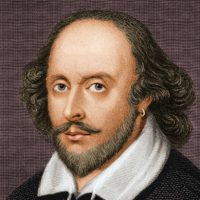
Researchers have decided Christopher Marlowe’s work on Shakespeare’s plays was extensive enough that he deserves a credit in future editions. My interlectual response is pugwash! Seems odd as Marlowe died around the same time that Shakespeare started to write his plays. He was apparently stabbed in a tavern. There is some rubbish about him working as a government spy and his death might have been choreographed but come on, give me a break!
Four key theories apparently argue as to why Shakespeare did not write his plays:
Theory 1 – As an individual of common birth, there is no way that such an individual would have the necessary grasp of languages, the classics, political theory, and history, necessary to write such works, whereas a high born and educated gentleman would.
Theory 2 – Given the sheer number of plays, poems, and sonnets, it would be impossible for a single individual to produce so extensive a body of work.
Theory 3 – Linguistically and structurally, it has been suggested that both the language and writing style is far too varied, and would therefore point to several authors – and not necessarily including Shakespeare.
Theory 4 – There is too little contemporary documentation linking Shakespeare to the plays and writings of associated to the ‘Bard’. It cannot therefore be conclusively shown that Shakespeare is the author.
Counter arguments to him writing his plays are:
- There are references all through Shakespeare’s works to his home area, (e.g. the forest of Arden) to the glover’s trade, which was his father’s showing a detailed understanding of the trade.
- He was well known in a relatively close knit society. He was part of a troop of players who worked openly among themselves, each of them taking on various jobs related to putting on their plays, besides their stage work. There was no specialisation in theatre. they didn’t have the luxury of rehearsing a play for a month or two and they spent a lot of time on the road together (especially during plague season) this gave him a lot of time to write.
- He was well known among his own contemporary playwrights. Ben Jonson was a great rival of his and also a great admirer. He might have fooled some but I doubt he could have fooled a playwright of the stature of Ben Jonson. Not one playwright during his own lifetime ever suggested that he was not the author of his own plays. With the rivalries and the strong jealousies this argues strongly for Shakespeare’s authenticity.
- His education amounted to a Classics education at university level in modern times and he was not without access to literary sources. He borrowed from sources freely and often and he was not concerned with developing his own plots. This evidences the works of a man as active as he was and a man of genius.
- His own people were related to ranking Catholic families in an era of persecution which would have made ties even closer. We know that London was a port city and as such, cosmopolitan, so that these names and the place names abroad would not have been out of his knowledge.
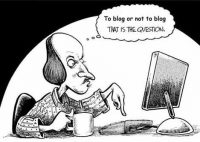
In my mind whilst you can always throw theories as to why he was not the sole author there are just as many common-sense arguments supporting him. Unless we can invent a time, machine and go back and ask him ourselves I prefer to remain with the theory that the guy was a genius and he would have been found out 400 years ago if it was any different.
I’ll think I’ll go back to climbing trees and me conkers!
I hope you enjoyed the read
Rich
PS: here are his plays in year order:
1589 – Comedy of Errors
1590 – Henry VI, Part II & Henry VI, Part III
1591 – Henry VI, Part I
1592 – Richard III
1593 – Taming of the Shrew & Titus Andronicus
1594 – Romeo and Juliet & Two Gentlemen of Verona & Love’s Labour’s Lost
1595 – Richard II & Midsummer Night’s Dream
1596 – King John & Merchant of Venice
1597 – Henry IV, Part I & Henry IV, Part II
1598 – Henry V & Much Ado about Nothing
1599 – Twelfth Night & As You Like It & Julius Caesar
1600 – Hamlet & Merry Wives of Windsor
1601 – Troilus and Cressida
1602 – All’s Well That Ends Well
1604 – Othello & Measure for Measure
1605 – King Lear & Macbeth
1606 – Antony and Cleopatra
1607 – Coriolanus & Timon of Athens
1608 – Pericles
1609 – Cymbeline
1610 – Winter’s Tale
1611 – Tempest
1612 – Henry VIII